Weekly Trade Information-215
author: SNC | Good Fortune
2026-11-06


Why Has Collagen Peptide Taken the Lead in Sports Nutrition?
Collagen peptides are enzymatic hydrolysates of collagen. Using specific proteases such as collagenase, bromelain and papain, large-molecule collagen is broken down into small peptide fragments with higher bioavailability. This process greatly reduces molecular weight and alters the spatial conformation of peptide chains, delivering superior water solubility, lower viscosity and improved absorption across the intestinal epithelium. Since different proteases cleave at distinct sites, composite enzymatic hydrolysis can further boost the degree of hydrolysis and peptide diversity, enhancing both absorption and functional performance. Compared with native collagen, collagen peptides show marked improvements in digestibility, solubility and processing tolerance, making them widely adopted in oral nutritional supplements, functional foods and beverages.
From a market perspective, population ageing has fuelled rising demand for nutritional supplements targeting skin, joint and bone health. According to WISE GUY research, the collagen peptide market reached approximately USD 4.06 billion in 2025 and is projected to grow to USD 8 billion by 2035.
(Source: Food Business Network)
New Raw Material: Reduced Coenzyme Q10 for Chewable Tablets
Gongjing Technology has launched its new CrysQnol™ reduced coenzyme Q10 raw material tailored for chewable tablets this week. Leveraging micro-encapsulation technology, the ingredient delivers improved oxidative stability and masks the bitter taste, with higher bioavailability compared with conventional ubiquinone formulations.
It can be directly incorporated into dietary supplements and functional compressed candies, ideal for formulas focusing on senior care and anti-fatigue, and eligible for China’s health food filing pathway. Reduced coenzyme Q10 has maintained steady demand in cross-border orders in recent years. This new chewable-grade variant facilitates end-product development for small-batch brand clients across Southeast Asia and Europe.
(Source: Health Net)


Creatine Gains Traction amid the Longevity Boom, Premium Formats Command Notable Price Premiums
Reported by NutraIngredients on 5 November, creatine is emerging as one of the most promising ingredients within the longevity segment. Data from Innova Market Insights shows that creatine grew roughly three times faster than the overall supplements market between 2022 and 2025. From January to August 2026, new product launches containing creatine rose by 62% year‑on‑year. Among these, new launches targeting non‑gym settings jumped by 194.7%, while new formulations blending creatine with electrolytes, HMB, collagen, magnesium, citicoline and other ingredients surged by 134%.
In terms of pricing, the median price for standard unflavoured creatine powder stands at approximately EUR 73 per kilogram. “Creatine‑plus” powders fortified with bioactive ingredients reach around EUR 222 per kg, and further processed formats including bars, chewable tablets and gummies can hit EUR 275 per kg — nearly four times the price of conventional powder. Industry insiders recommend that manufacturers build premium differentiation through high purity, third‑party testing, patented ingredients and clearly labelled dosages.
(Source: NutraIngredients)
EFSA Releases Safety Assessments for Novel Protein Raw Materials, Regulating Market Access for Cultivated Meat and Insect Protein
This week, the European Food Safety Authority (EFSA) finalised authoritative safety assessment reports for three novel alternative protein ingredients. The assessments focus on the genetic stability of cultivated meat, safety of residual culture media, and allergenic risks of newly processed insect protein. The reports set out clear toxicological and biosafety benchmarks that these ingredients must satisfy before entering the European market, offering straightforward regulatory guidance for global food-tech companies pursuing compliant commercial launch of alternative protein raw materials.
(Source: EFSA Official News)

South Korea Tightens Import Screening for Cross‑Border Supplements
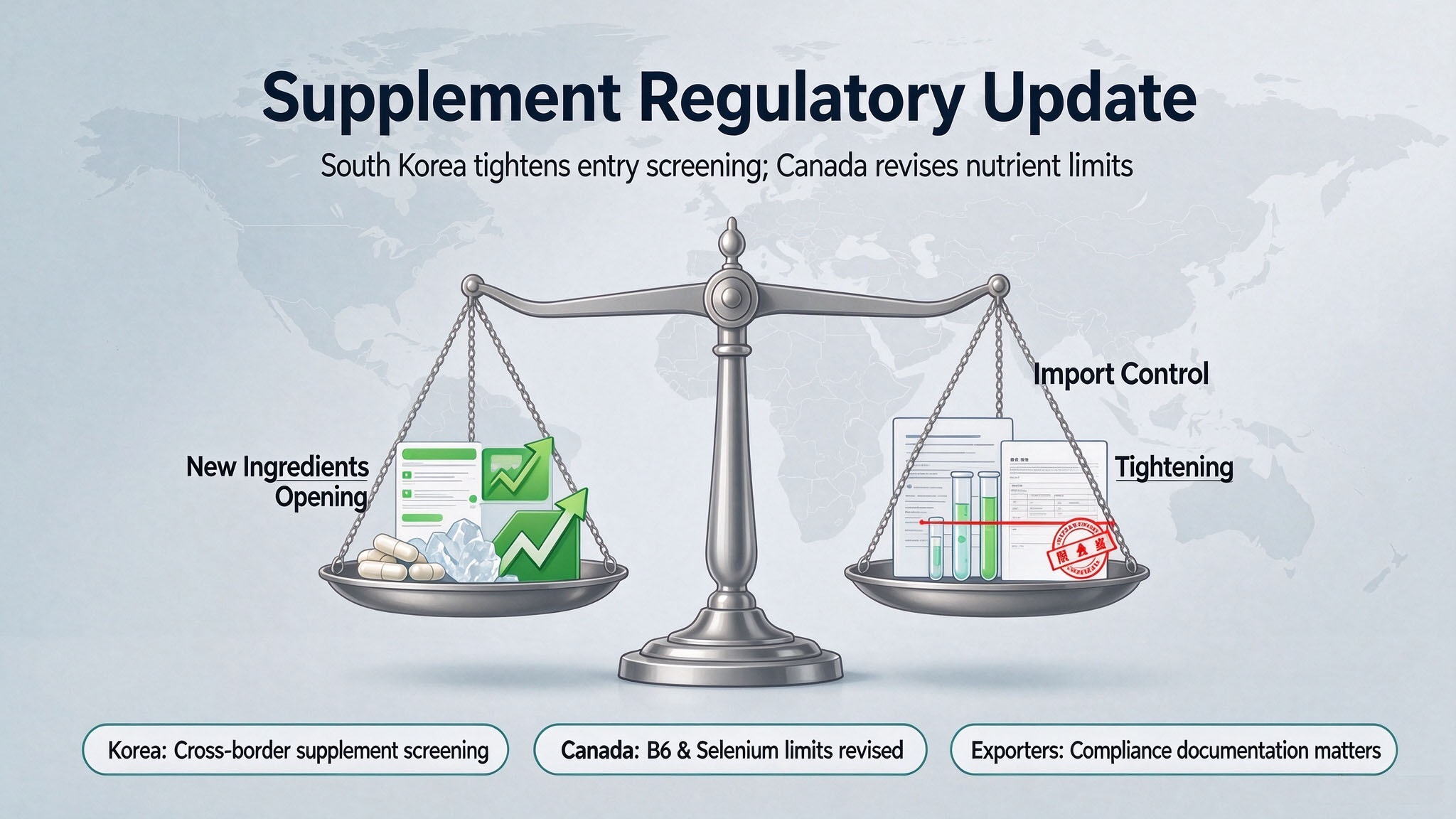
South Korea’s Ministry of Food and Drug Safety issued an alert this week. Multiple imported supplements targeting height support and brain health were found to contain restricted ingredients including 5‑HTP during random testing, prompting stricter entry screening for cross‑border dietary supplements. Meanwhile, it released a draft revision for functional food regulations, proposing to lift the daily intake cap for probiotics and adding sturgeon cartilage protein complex to the permitted raw material list.
In parallel, Canada published a proposal to lower the maximum permitted levels of vitamin B6 and selenium in supplement foods and update labelling warning requirements. Overseas markets are following a pattern: approving new ingredients while tightening controls over claimed functions and dosage limits, with more rigorous reviews of compliance documentation for Chinese exporters.
(Source: NutraIngredients)
Shipping Routes Gradually Stabilise with Moderate Freight Rate Correction
Space availability on Southeast Asia and Europe lanes has recently stabilised alongside a slight freight rate pullback, yet inspection rates for shipments of food additives and powdered plant extracts have risen. Shipping lines have tightened requirements for MSDS and UN packaging certification documents for powder and microencapsulated raw materials; incomplete paperwork commonly results in cargo rolling and port detention.
Several freight forwarders have launched dedicated lanes for nutritional ingredients, prioritising shipments with complete commodity inspection and certificates of origin. In the short term, congestion at European ports has eased. Nonetheless, as the year‑end peak approaches, booking lead times are extending. Exporters of supplement raw materials are advised to secure space in advance and prepare the full set of compliance documents to avoid shipment delays.
(Source: Shipping Info)

Weekly Trade Information-216
Weekly Trade Information-214
Related Article

The New Anti Aging Star: “Plant Derived Retinol” — Harungana Extract
Cyclocarya Paliurus Leaf Polyphenols: Upgraded Applications of a Characteristic Botanical Resource
Rice Protein: Potential for Cat Food Development
Cyclocarya Paliurus Leaf Polyphenols: Upgraded Applications of a Characteristic Botanical Resource
Rice Protein: Potential for Cat Food Development
Weekly Trade Information-216

The Underestimated Wild Fruit! This "King of Vitamin C" Helps Alleviate Intestinal Inflammation
New Ingredient Launch: DurOmega Krill Oil Microcapsule Powder
AstraGin® Astragalus and Panax Notoginseng Extract: Boost Nutrient Bioavailability by Enhancing Intestinal Absorption
New Ingredient Launch: DurOmega Krill Oil Microcapsule Powder
AstraGin® Astragalus and Panax Notoginseng Extract: Boost Nutrient Bioavailability by Enhancing Intestinal Absorption
Weekly Trade Information-214

China’s First 63% High-Phospholipid Krill Oil Raw Material Launched
Creatine: A Prime Example of Synergistic Development Between Raw Material Upgrading and Dosage Form Innovation
King Hero Re-engineers Formulation Logic with Ginseng Coffee Bean Blend; Functional Beverages Shift toward Clean Plant-Based Alternatives
Creatine: A Prime Example of Synergistic Development Between Raw Material Upgrading and Dosage Form Innovation
King Hero Re-engineers Formulation Logic with Ginseng Coffee Bean Blend; Functional Beverages Shift toward Clean Plant-Based Alternatives
Weekly Trade Information-213